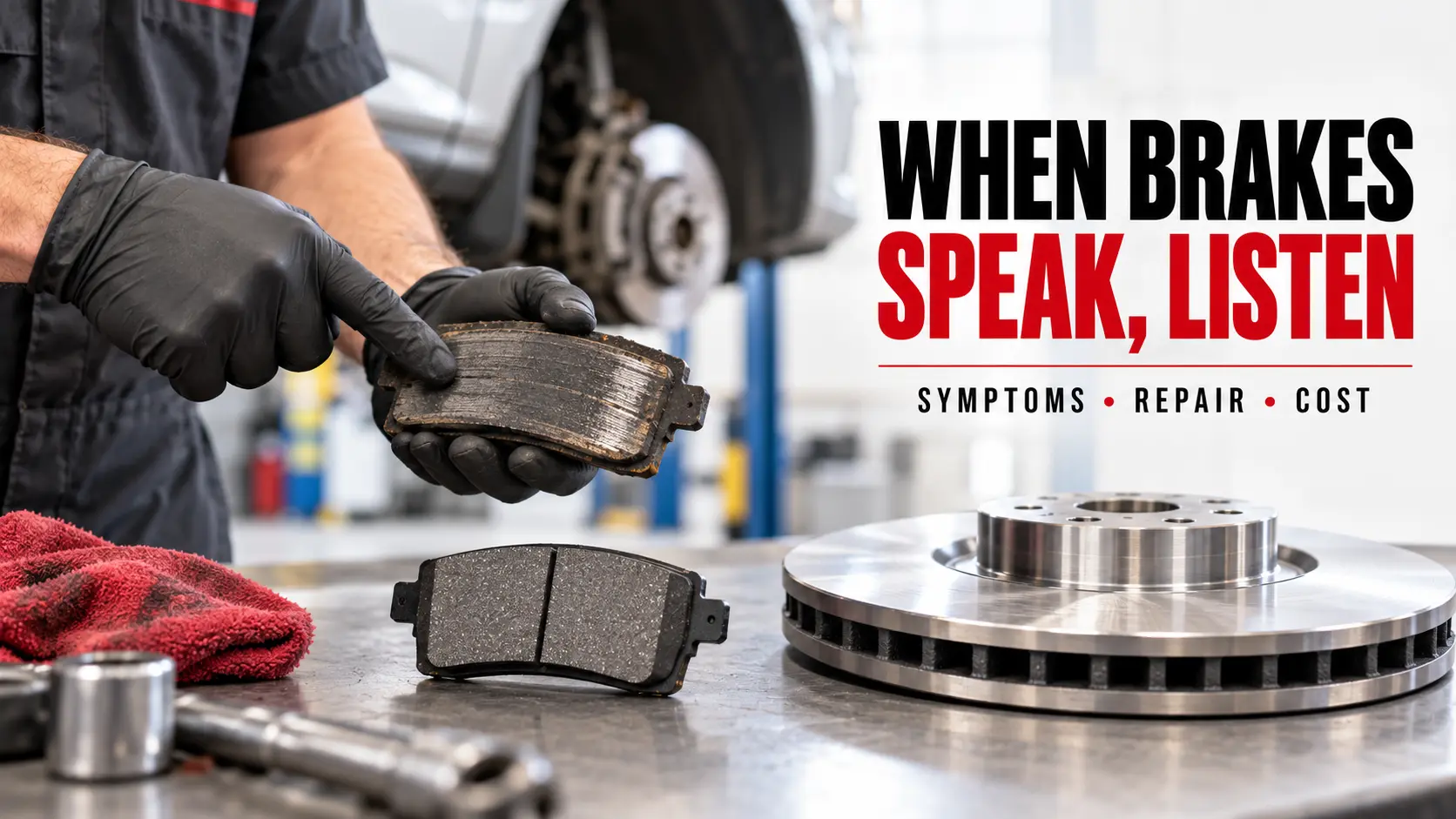
Your braking system is your vehicle's single most critical safety component. Here is how to diagnose warning sounds, understand Cook County winter wear patterns, and calculate real-world repair costs before minor squeaks become dangerous mechanical failures.
Driving throughout the greater Chicago metropolitan area places punishing demands on automotive braking systems. Between stop-and-go congestion on the Kennedy Expressway (I-90), abrupt stops along commercial thoroughfares like Rand Road and Golf Road, and the heavy application of liquid magnesium chloride deicers during freezing Midwest winters, your brakes work harder here than almost anywhere else in the country.
Over time, normal friction wear transitions into acoustic warning signs. Many drivers ignore high-pitched squeals, hoping the sound will simply disappear, only to be startled weeks later by a violent metal-on-metal grinding noise that doubles their repair bill.
At Autos of Chicago Service Center, located at 1555 East Rand Road in Arlington Heights, IL, our ASE-certified technicians diagnose and repair hundreds of braking systems every month. Below is our comprehensive 2026 technical guide breaking down brake symptoms, micrometer measurements, repair cost matrices, and coupon savings.
Acoustic & Mechanical Diagnosis: Squeal vs. Grind vs. Spongy Pedal
Modern disc brake assemblies communicate their physical condition through distinct sounds and tactile pedal feedback. Here is how to identify what your car is telling you:
-
1. The High-Pitched Metallic Squeal (Wear Indicator Contact):
Most factory and premium aftermarket brake pads feature a small, tempered steel tab known as an acoustic wear indicator. When the friction material wears down to 3.0 millimeters (roughly 25% remaining life), this steel tab begins lightly contacting the spinning cast-iron rotor during pedal application. It emits a loud squeal designed specifically to alert you that pad replacement is due before the rotor surface suffers damage. -
2. The Harsh Metal-on-Metal Grind (Total Friction Lining Depletion):
If squealing is ignored, the friction lining wears completely away to 0.0 millimeters. When this occurs, the solid steel backing plate of the brake pad clamps directly against the rotor face. This creates an aggressive mechanical grinding noise, violent vibrations in the chassis, and rapid gouging of the rotor disc. Continuing to drive in this condition creates extreme heat friction that can boil brake fluid and weld caliper pistons in place. -
3. The Pulsating Pedal or Steering Wheel Shudder (Rotor Runout):
If your brake pedal vibrates underfoot or the steering wheel shakes violently when slowing down from 55 MPH on Route 53, your brake rotors have developed lateral runout or uneven disc thickness variation (often referred to as "warped rotors"). This occurs when intense thermal cycling causes friction material to imprint unevenly across the metal rotor face. -
4. The Spongy or Sinking Pedal (Hydraulic Compromise):
If your brake pedal feels soft, sinks toward the floorboards at a red light, or requires pumping to achieve stopping power, the issue lies within the hydraulic fluid circuit. Brake fluid is hygroscopic (it naturally absorbs atmospheric moisture). When moisture exceeds 3.0%, boiling resistance drops, creating compressible vapor pockets in the caliper lines.
⚡ Arlington Heights Brake Service Special
Hearing Noises When You Stop? Get a Free Inspection
Take advantage of our Complimentary Brake Inspection. If replacement is needed, save up to $100 off your complete pad and rotor package with coupon code BRAKE100W.
The Hard Data: Safe Thickness Tolerances vs. Discard Specs
Automotive braking safety is governed by precise engineering tolerances measured with digital vernier calipers and dial micrometers:
- New Brake Pad Thickness: Brand-new friction pads measure between 10.0 mm and 12.0 mm (approx. 0.45 inches).
- Recommended Maintenance Threshold: At 4.0 mm to 5.0 mm, pads have lost over 60% of their thermal heat dissipation capacity and should be scheduled for replacement.
- Illinois Minimum Safety Discard Limit: At 3.0 mm (or 2/32-inch), pads must be replaced immediately. Below this thickness, friction material can shear off the backing plate under hard emergency braking.
- Rotor Lateral Runout Limit: Rotor face variation must not exceed 0.002 inches (0.05 mm). Anything greater causes steering oscillations and pulsating pedal feel.
Cost Breakdown: Autos of Chicago vs. Dealership vs. Chain (2026 Data)
Brake repair pricing varies significantly depending on whether you replace only friction pads or complete pad-and-rotor packages across the front or rear axle. Here is how real-world pricing in the Northwest Suburbs compares:
| Service Scope (Per Axle) | Parts & Procedures Included | Autos of Chicago | Franchise Dealership | National Chain |
|---|---|---|---|---|
| Brake Pads Only (Front or Rear) | Premium ceramic/semi-metallic pads, new abutment clips, slide pin cleaning & synthetic grease. | $175 – $240 | $350 – $475 | $220 – $290 |
| Complete Pad & Rotor Package | New ceramic pads, 2 new coated corrosion-resistant rotors, hardware kit, caliper slide pin overhaul. | $320 – $440 ($220–$340 with coupon BRAKE100W) |
$580 – $750 | $450 – $560 |
| Complete Hydraulic Fluid Flush | Complete pressure evacuation and bleed with fresh DOT 3/DOT 4 fluid; moisture test printout. | $85 – $110 | $175 – $225 | $110 – $145 |
⚠️ Master Technician Warning: The "Pad-Slap" Trap:
Budget repair shops frequently advertise cheap "$99 brake specials" where they perform a quick "pad-slap"—installing brand-new flat pads directly onto heavily grooved, heat-stressed old rotors without turning or replacing them. In Cook County, this practice almost guarantees loud squealing within 500 miles. Furthermore, because grooved rotors have diminished contact surface area, your emergency stopping distance can increase by up to 25 feet.
Professional Tools & Equipment: How Brakes Are Inspected Properly
At Autos of Chicago, we do not inspect brakes by merely looking through the wheel spokes. Our technicians follow a systematic open-wheel diagnostic protocol using industry-standard tools:
- Digital Micrometer Rotor Profiling: Using calibrated Snap-on digital micrometers, technicians measure rotor thickness at eight separate points around the disc perimeter to verify that the rotor remains safely above the cast-in minimum discard specification.
- Rotor Lateral Runout Dial Indicators: Rotors are measured with precision dial indicators while mounted to the hub to confirm lateral runout is within 0.002 inches, preventing pedal pulsations.
- Brake Fluid Boiling Point & Moisture Testing: Using Bosch electronic fluid testers, we measure the boiling point and percentage of water dissolved in your hydraulic brake lines.
- Caliper Slide Pin De-Seizing & Synthetic Lubrication: Winter road salt frequently corrodes floating caliper slide pins, locking one pad against the rotor and causing rapid tapered wear. We clean, polish, and lubricate all pins with high-temperature silicone ceramic brake grease.
How to Choose: Selecting the Right Brake Pads for Midwest Driving
When replacing brake pads, choosing the right friction compound determines your stopping bite, wheel dust, and cold-weather performance:
-
1. Ceramic Friction Compounds (Recommended for 90% of Daily Drivers):
Brands like Akebono ProACT, Bosch QuietCast, and Wagner OEX blend ceramic fibers with non-ferrous filler materials. Ceramic pads produce virtually zero black brake dust, operate silently, and offer gentle rotor wear. They deliver consistent stopping power across freezing Chicago winter mornings and hot summer commutes. -
2. Semi-Metallic Compounds (Best for Heavy Trucks & Towing):
Semi-metallic pads incorporate 30% to 65% steel, iron, and copper fibers. They offer higher thermal fade resistance and aggressive initial bite, making them ideal for full-size pickups (Ford F-150, Silverado) and heavy SUVs towing trailers. The trade-off is higher rotor wear and visible metallic brake dust on alloy wheels. -
3. Fully Coated Rotors (Essential for Illinois Salt Resistance):
Always request fully geomet-coated or electro-coated (E-coated) rotors. Uncoated budget rotors develop heavy rust on the cooling vanes and center hats within weeks of winter road salt exposure, resulting in rust flaking and structural rotor degradation.
Got Questions About Brake Repair in Arlington Heights?
Everything you need to know about squealing sounds, rotor wear limits, and available coupon discounts.
Why do my brakes squeak in the morning during humid or cold Chicago weather?
Can I replace just my brake pads and reuse my existing rotors?
How much does a full brake pad and rotor replacement cost in Arlington Heights in 2026?
What causes a soft or spongy brake pedal?
How do I claim the free brake inspection and $100 coupon at Autos of Chicago?
Stop with Absolute Confidence in Arlington Heights
Don't let worn brake pads ruin your rotors or compromise your safety. Book your complimentary brake inspection today and save up to $100 on complete pad and rotor service.
Service Facility: 1555 East Rand Road, Arlington Heights, IL 60004
Direct Service Desk: (224) 888-4007
Hours: Monday – Friday: 8:00 AM – 6:00 PM | Saturday: 8:00 AM – 4:00 PM
VIP Ownership Perks Included with Vehicle Protection Plans
Customers who safeguard their investment with an extended service contract through Autos of Chicago gain access to our complete suite of dealership ownership perks—including scheduled synthetic oil services, comprehensive multi-point safety inspections, 24/7 emergency roadside assistance, and professional post-purchase detailing certificates. Learn more about plan options on our vehicle protection plans page.
*Program Terms & Qualification Disclaimer: Ownership perks, maintenance credits, roadside assistance, detail vouchers, and trade-in bonuses referenced across our website and promotional materials are available exclusively to qualified customers who purchase an eligible extended vehicle protection plan or vehicle service contract at Autos of Chicago at the time of vehicle sale. Vehicle eligibility varies based on make, model, age, mileage, and underwriting approval from participating warranty administrators. Complimentary services are non-transferable, carry no cash value, and are administered strictly according to the specific written schedule, coverage tiers, and deductible provisions detailed in your signed agreement. Cannot be combined with standalone wholesale clearance pricing unless approved in writing by dealership management. Visit our Arlington Heights showroom or contact our finance department at (224) 888-4007 for complete written terms, exclusions, and vehicle qualification details.


