Hidden Costs of Luxury Car Ownership
First-time luxury car buyer? Every vehicle on our Arlington Heights lot is up to $1,700 off through July 31 — one less hidden cost. Browse the inventory →
Insurance, tires, brakes, premium fuel, wheel repair, windshields. Owning a Mercedes, BMW, Audi, or Range Rover costs more than owning a Camry — but the “more” hides in categories most first-time luxury buyers don’t budget for.
The story of a first-time luxury car buyer follows a familiar arc. They saved for years, finally bought the BMW or the Mercedes they had been dreaming about, drove it home glowing, and six months later got a $2,400 tire bill they had no idea was coming.
Luxury cars deliver a driving experience, an interior, and a mechanical refinement that mainstream cars cannot match. They also come with recurring costs that live in categories most first-time buyers never think to research. The purchase price is not the surprise. The ongoing cost is.
This is what we tell every customer who walks onto our Arlington Heights lot considering their first luxury vehicle. None of it should stop you from buying the car you want. All of it should shape how you budget for it.
Cost #1 — Insurance Premiums
The most predictable jump, and the one buyers most often underestimate.
A luxury vehicle costs more to repair and more to replace, which insurance carriers price accordingly. A typical Chicago-area driver moving from a Toyota Camry to a BMW 5 Series can expect their annual premium to rise roughly 25–45 percent — often $500 to $1,200 more per year for the same driver profile and coverage level.
Luxury and performance trims cost more still. AMG, M, RS, and SVR variants often insure at 60–80 percent more than their standard counterparts because their higher horsepower puts them in different rating categories.
How to plan: Get an insurance quote before you buy, on the exact make and model you are considering. Do not assume your current premium will apply.
Cost #2 — Tires
Here is where most first-time luxury owners get their first shock. A set of four all-season tires for a Toyota Camry runs $600–$900 installed. A set of four for a BMW 540i, Mercedes E-Class, or Audi A6 runs $1,400–$2,200 installed. A set for a Range Rover, X5 M, or AMG GLS on 22-inch wheels can exceed $3,000.
The reasons luxury tires cost more:
- Larger diameters. 19-, 20-, 21-, and 22-inch wheels require larger, more specialized tires.
- Lower profiles. Low-profile tires have less rubber but cost more, largely because they are performance-rated.
- Performance and Y/W speed ratings. Required to match the car’s capability.
- Run-flat construction. Many BMWs and some Mercedes use run-flat tires. They cost 30–50 percent more than standard tires and cannot be repaired if punctured — a nail in the sidewall means a new tire.
- Staggered fitment. Many performance sedans use different-size front and rear tires, which means no rotation, which means faster wear.
How to plan: Google the tire size for your specific model and pull real prices from Tire Rack before buying. A set every 25,000–35,000 miles is realistic for most driving.
Cost #3 — Brakes
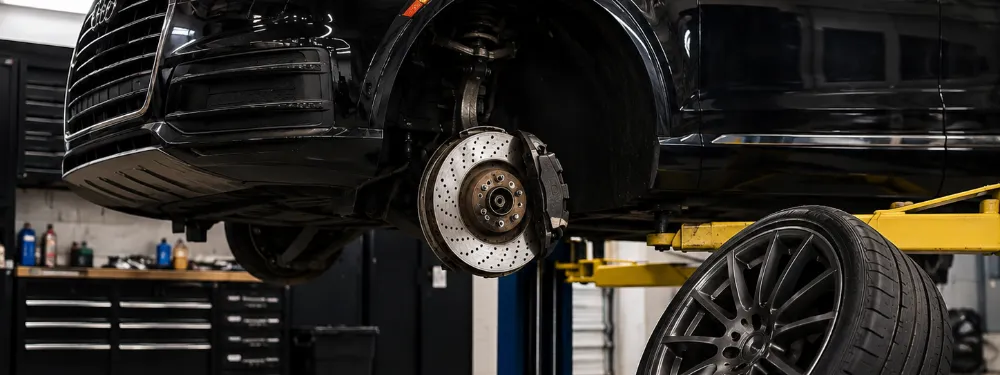
Luxury cars have larger rotors, heavier calipers, and more sophisticated pad compounds designed to work at higher speeds and with more heat. That performance translates to shorter service life and higher replacement cost.
- Toyota Camry brake job (pads and rotors, both axles): $700–$1,000.
- BMW 5 Series brake job (pads and rotors, both axles): $1,400–$2,000.
- Range Rover, X5 M, or AMG brake job: $2,500–$4,500.
- Ceramic composite brakes (found on high-end AMG, M, RS, and Porsche models): a full replacement is $8,000–$15,000+.
How to plan: Budget for a brake job somewhere between 40,000 and 65,000 miles depending on driving style. If you drive aggressively, expect to be at the lower end.
Cost #4 — Premium Fuel
Almost every luxury and performance vehicle from Germany requires 91 or 93 octane premium fuel. Premium runs about 60–80 cents more per gallon than regular in the Chicago area. On a car averaging 25 mpg and 12,000 miles per year, that is roughly $350–$450 more per year in fuel.
It is not a huge number, but it is a permanent number. Every fill-up. Forever.
How to plan: Add roughly $30–$40 to your monthly fuel budget when moving from a regular-fuel commuter car to a premium-fuel luxury car.
Cost #5 — Oil Changes and Scheduled Service
At the dealership, a BMW or Mercedes oil service runs $180–$300. Most luxury cars use extended-drain-interval synthetic oil, so services happen every 10,000–15,000 miles rather than every 5,000 for a mainstream car. Net cost is roughly similar per year, sometimes a little higher.
The bigger scheduled-service costs come at longer intervals — brake fluid service, cooling system service, transmission fluid service, spark plugs, cabin filters, and battery service. Each of these runs $200–$600 depending on the item and the model.
How to plan: Independent luxury specialists like our in-house shop typically charge 30–50 percent less than the dealership on the exact same work. Building a relationship with a good independent shop is one of the highest-leverage cost reductions in luxury ownership.
Cost #6 — Wheel Repair (Curb Rash)
This is the one nobody warns you about. Big luxury wheels on low-profile tires are far more vulnerable to curb rash — a single misjudged parking maneuver leaves a permanent scuff on a $1,200 wheel.
Professional wheel repair on a forged luxury wheel runs $250–$450 per wheel. Some diamond-cut and multi-piece wheels require full refinishing at $600+ per wheel. Bent wheels (from a pothole strike) can run $400–$800 to straighten, or the wheel needs replacement — a factory 20-inch AMG or M wheel can run $2,500 individually.
How to plan: Buy wheel-and-tire insurance if your dealer offers it. Otherwise, budget one professional wheel repair every year or two if you park in the city or in tight garages.
Cost #7 — Windshield Replacement
A luxury windshield is not a piece of glass. It is a laminated multi-layer sensor housing. Modern BMWs, Mercedes, and Audis integrate:
- Rain and light sensors
- Heads-up display (HUD) projection layer
- Advanced driver assistance camera housing
- Sometimes acoustic dampening layers
- Sometimes heated element grids
Result: what would be a $350 windshield replacement on a Toyota is a $1,200–$2,200 replacement on a BMW or Mercedes with HUD and ADAS cameras. After replacement, the ADAS cameras must be recalibrated — another $200–$400 job. Some are static calibrations, some are dynamic road calibrations.
How to plan: Comprehensive insurance with glass coverage is worth the small premium bump on any luxury car. Full-coverage state programs (like Illinois’ zero-deductible glass laws in specific policy tiers) are your friend.
Cost #8 — Battery Replacement (And Registration)
Modern luxury cars use AGM batteries — heavier-duty and more expensive than standard flooded batteries. An AGM battery for a BMW or Mercedes runs $400–$600. But the surprise is that a new battery must be registered to the car’s battery management system through the factory diagnostic platform (ISTA on BMW, XENTRY on Mercedes, ODIS on Audi, Pathfinder on Land Rover). Skip this step and the alternator will overcharge the new battery, ruining it inside a year.
Independent luxury specialists can register batteries. Most general auto shops cannot.
Total cost with registration: $500–$800 every 4–6 years.
How to plan: Every time you replace a battery, confirm the shop can register it to your car. If they cannot, find another shop.
Cost #9 — Depreciation on Optional Extras
Every luxury car has an option sheet. Buyers new to the segment often chase every option — Executive Package, Driver Assistance Plus, Premium Package, Bowers & Wilkins audio, ventilated seats, air suspension, active cruise. On the new-car sticker, options add $8,000–$25,000 quickly.
At resale, most of that money is gone. Optional packages depreciate faster than base MSRP.
How to plan: If you are buying used, this depreciation has already happened — you get the fully loaded car at a fraction of its option value. This is the single biggest financial argument for buying luxury used instead of new.
Cost #10 — Dealership vs. Independent Service
Every dollar of the maintenance and repair costs above is calibrated on dealership pricing. The single biggest lever any luxury owner can pull is switching to a qualified independent specialist like our own service department.
At a real BMW / Mercedes / Audi / Land Rover independent specialist:
- Oil service: 40–60 percent less
- Brake job: 30–45 percent less
- Cooling system repair: 30–40 percent less
- Air filter and cabin filter: 50–70 percent less
- Battery replacement and registration: 30–40 percent less
The specialist uses the same OEM parts, the same approved fluids, and often the same factory diagnostic platforms. The savings come from lower labor rates and lower overhead, not lower quality.
How to plan: Identify a qualified independent specialist in your area before your first out-of-warranty service. Do not wait until something breaks.
The Realistic Total
If you are moving from a mainstream mid-size sedan to a mid-luxury sedan like a BMW 5 Series or Mercedes E-Class, budget roughly $150–$225 per month more in total ownership cost — insurance, fuel, tires, maintenance, and reserve for repairs.
If you are moving to a heavier luxury SUV like a Range Rover, X7, GLS, or Q7, budget $300–$500 per month more.
If you are moving to a high-performance variant (AMG, M, RS, SVR), budget $500–$800 per month more.
None of these numbers should stop you if you want the car. All of them should shape the budget you set before you buy.
The One Cost That Rewards You
Luxury cars retain their appeal longer than mainstream cars. A ten-year-old E-Class still feels like an E-Class. A ten-year-old Camry feels like a ten-year-old Camry. That emotional and mechanical staying power is what makes luxury ownership worth it for the right buyer.
The trick is to plan for the recurring costs upfront so they never surprise you, and to build a relationship with an independent specialist who keeps the ongoing cost as low as it can honestly be.
Shop Confidently at Autos of Chicago
We sell luxury vehicles across BMW, Mercedes-Benz, Audi, Land Rover, Porsche, Tesla, and more, and we service them in our own in-house shop. Every buyer we work with gets a straightforward conversation about not just the vehicle price but the realistic ongoing cost.
Come by our Arlington Heights lot and we will walk you through the exact cost picture of any vehicle you are considering. If you want to line up financing before you shop, our team can sort that out too.
Or call us at (224) 858-4007 for an honest conversation about your first luxury car.
Address: 1555 E Rand Rd, Arlington Heights, IL 60004