
Expert contributor: Chris K, General Sales Manager at Autos of Chicago, with 15+ years in car sales. The dealership examples below reflect Chris’s interview account of cases handled by the team.
Quick answer: You can get a CARFAX report by entering a car's VIN or license plate at carfax.com and buying a report, or free from most dealer listings. Every pre-owned vehicle on our Arlington Heights lot comes with a free CARFAX report. Below is every way to get one, followed by how to read it.
How to Get a CARFAX Report
1. Free from a dealer listing
Most dealers include a free CARFAX report on their used vehicles. Look for the CARFAX logo or a "View Free CARFAX Report" link on the vehicle page. Every vehicle in our used inventory includes one, so you can open the report before you ever visit.
2. Buy one on carfax.com
For a car from a private seller, go to carfax.com and enter the 17-character VIN (found on the driver's side dashboard, the door jamb sticker, or the title) or the license plate. Reports are sold individually or in multi-report packages. Check carfax.com for current pricing.
3. Free partial checks
These don't replace a full report, but they cost nothing:
- NICB VINCheck: shows whether the car was reported stolen and not recovered, or declared a total loss by participating insurers.
- NHTSA recall lookup (nhtsa.gov/recalls): shows open safety recalls for the VIN.
4. Ask the seller
A reputable dealer will hand you the CARFAX for any car on the lot at no charge. If a seller won't share a vehicle history report, treat that as a warning sign.
| Option | Cost | Shows full history? | Best for |
|---|---|---|---|
| Dealer listing | Free | Yes | Cars for sale at a dealership |
| carfax.com | Paid | Yes | Private-sale cars |
| NICB VINCheck | Free | No: theft and total loss only | A quick first check |
| NHTSA recall lookup | Free | No: recalls only | Checking for open recalls |
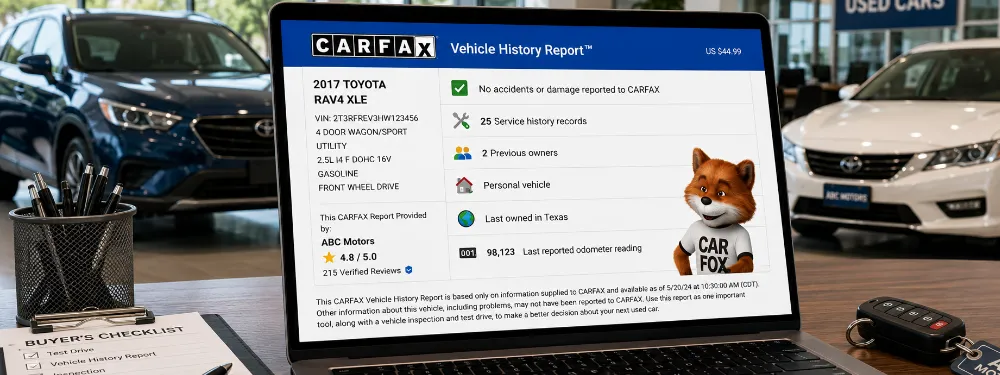
CARFAX can show reported accidents and damage, title brands, ownership and registration history, mileage readings, service and repair records, vehicle use, theft and recovery, total-loss records, and open recalls. What appears depends on the information available for that vehicle.
That makes it useful when buying a used car. It does not make it a mechanical inspection or a guarantee that every event appears.
At Autos of Chicago in Arlington Heights, the misunderstanding we encounter most often is simple: buyers treat a clean CARFAX as a clean bill of health. Our team uses the report to decide what needs investigating, then checks the vehicle itself.
What does CARFAX show
| Information | What you may see |
|---|---|
| Vehicle identity | VIN and vehicle details |
| Accident and damage history | Reported incidents, severity, impact location, airbags, and structural damage |
| Title history | Salvage, rebuilt, flood, fire, junk, lemon, and mileage-related brands |
| Ownership history | Estimated owners, ownership duration, and registration locations |
| Mileage | Dated odometer readings and possible inconsistencies |
| Service and repairs | Reported maintenance and component repairs or replacements |
| Vehicle use | Personal, lease, rental, commercial, taxi, or police use |
| Theft and loss history | Reported theft, recovery, and total loss |
| Recalls and inspections | Reported open recalls and inspection results |
CARFAX explains its coverage in its report overview and customer-support guide.
Read each row as information that may be available, rather than a promise of complete coverage. A blank service timeline tells you that records are missing from the report. It does not tell you why.
What a clean CARFAX cannot establish
A report cannot establish today’s brake thickness, battery health, transmission behavior, repair quality, or underbody corrosion. Unreported repairs and maintenance can leave gaps.
Our team evaluated a 2021 BMW X3 with one reported owner, a clean title, and no reported accident or damage. The lift inspection found overspray, non-factory seam sealer, and clamp marks on a unibody rail.
There were other clues: scraping inside the front passenger wheel, a recently replaced aftermarket control arm beside older factory suspension parts, and a cracked steering-rack housing. After our manager showed the owner the findings, the owner confirmed that the vehicle had struck a concrete median curb and been repaired out of pocket.
Our estimated correction cost for the alignment, steering rack, and suspension geometry was about $4,500. We excluded it from retail inventory and sent it to wholesale.
Paying cash does not guarantee that a repair stays off CARFAX; another source could report it. In this case, the report available to us did not show the event. The inspection supplied the missing evidence.
What our dealership records show
According to the internal figures supplied by Chris for January 1 through September 30, 2026, Autos of Chicago recorded:
| Stage | Vehicles |
|---|---|
| Evaluations and appraisals | 1,332 |
| Shop lift inspections | 614 |
| Retail clearances | 497 |
| Clean-CARFAX vehicles rejected for retail | 46 |
The 46 clean-report rejections represented 7.5% of all 614 inspected vehicles. That is not a rejection rate among clean-report vehicles alone: that denominator is not provided. It is also not an industry estimate or a measure of CARFAX’s accuracy.
It describes our inspected inventory and our retail standards. A clean report did not remove the need to inspect.
Accident severity needs repair evidence
An accident entry deserves attention. It does not supply the complete repair story.
Our team investigated a 2022 Audi Q5 45 TFSI Premium Plus, with about 31,500 miles, whose report described moderate front damage.
Paint readings and the lift inspection supported a different picture from the major wreck a buyer might imagine. Our technicians found no evidence of repair to the hood, front fenders, or pillars, and no observed deformation of the bumper reinforcement or core support. The collision-center repair order documented damage involving the grille, a headlight mounting tab, and radar alignment.
The repair bill exceeded $3,600, including an approximately $2,200 headlight and $800 radar recalibration. Those amounts show how expensive front-end electronics can be. They do not establish why CARFAX assigned its severity label.
We priced the Q5 at $32,400, against comparable accident-free listings ranging from $34,800 to $35,200. That was $2,400–$2,800 below the asking-price range, rather than a guaranteed discount against what those other vehicles eventually sold for.
The buyer received the repair documentation and our inspection findings. The vehicle sold in under 12 days.
Ask what was repaired, whether safety systems were checked or calibrated, and what evidence supports the repair quality. Also consider future resale: an accident entry may remain relevant to later buyers even after a satisfactory repair.
A CARFAX report can change after you first read it
A report’s creation date and an incident’s date are different things. Older events can appear later as information reaches the database.
We acquired a 2022 Lexus RX 350 with roughly 28,000 miles on a report showing no accidents. On Day 34, an updated report showed front/side damage from an incident dated nearly three months before acquisition.
Our team re-inspected the Lexus and found a resprayed passenger-side front fender blended into the door, without observed damage to the core support, apron, or suspension.
The financial impact was concrete:
| Item | Amount |
|---|---|
| Trade acquisition | $38,500 |
| Reconditioning | $950 |
| Acquisition plus reconditioning | $39,450 |
| Original asking price | $42,800 |
| Final selling price | $39,500 |
The sale left $50 above acquisition and reconditioning, before other expenses. That was $3,300 less than the margin implied by the original asking price.
We showed buyers the original report, updated report, and inspection findings. For shoppers, the practical step is to request a recently generated report again before purchase and investigate material changes. There is no single reporting-delay timeline that covers every source.
Missing service records do not prove neglect
A 2018 Toyota 4Runner TRD Off-Road, with about 68,000 miles, had a long service-record gap after its early dealership visits.
The owner supplied independent-shop invoices documenting maintenance that was absent from the CARFAX timeline. Our inspection also found reassuring fluid, tire, and driveline condition.
The receipts were the evidence of past work. The physical inspection helped assess current condition. Neither should be confused with a complete guarantee of engine health.
This is why we ask for outside invoices when a report has gaps. An independent shop or owner may have performed maintenance that never reached CARFAX.
More service entries can also mean more investigation
Our team evaluated a 2019 Ford Edge Titanium AWD 2.0L EcoBoost, with roughly 46,000 miles, showing 14 service records.
The important detail was the pattern: repeated cooling-system checks, ignition-part replacements, and drivability investigations. It prompted deeper diagnosis rather than reassurance from the record count.
A scan, cooling-system pressure test, and cylinder inspection led our team to identify an internal coolant-leak problem. Our engine-replacement estimate was $7,400. We excluded the vehicle from retail and wholesaled it with mechanical disclosure.
Repeated entries do not diagnose a failure by themselves. They tell a technician where to investigate. Read what happened at each visit, rather than counting visits as a quality score.
Mileage warnings need a documented explanation
Mileage readings should form a plausible timeline. A decrease or unusual jump needs investigation before you commit.
A 2020 Honda Accord 2.0T Touring showed 42,300 miles at appraisal, but an earlier tire-shop entry recorded 73,850 miles.
The original shop paperwork showed 37,850 miles. The reporting shop acknowledged the clerical error, and our team submitted supporting records to CARFAX. In this case, the entry was corrected and the warning removed within six business days.
That turnaround is this case’s outcome, not a promised correction time.
An incorrect report entry is also different from a mileage brand on the actual title. Verify both. Diagnostic information, where available for the model, can support an investigation, but worn pedals or matching electronic readings alone cannot prove a vehicle’s true mileage.
If a seller says “it is just a typo,” ask for the source record and the corrected report. CARFAX offers a research request process for concerns about reported information.
Owner count and state changes need context
Read the ownership timeline alongside the title and service records. A lease buyout, business-to-personal transfer, or relocation can complicate the story.
Our team evaluated a 2020 Porsche Macan S, with about 34,000 miles, whose report showed four owners and Illinois/Florida title activity.
The seller supplied records supporting continuous use by the same driver: an original business lease, personal lease buyout, relocation records, and service invoices. After reviewing the history and inspecting the vehicle, we increased our trade allowance from $38,500 to $42,000.
That did not erase the report’s four-owner designation. It gave us a documented explanation to present alongside it.
A title reissue does not automatically equal another owner. Likewise, a move through several states does not establish fraud, flooding, or poor maintenance. Ask what changed, who possessed the car, and whether the documents fit the timeline.
At Autos of Chicago, multiple owners alone are not a retail exclusion.
Rental and fleet labels describe use history
A former rental deserves the same evidence-based review as a personal vehicle. Neither label establishes how carefully it was driven.
We acquired a 2022 Toyota Highlander XLE AWD, with about 31,800 miles, carrying a fleet/rental designation. Its maintenance logs showed frequent oil services, and our physical inspection found reassuring body, interior, tire, and brake condition.
We retailed it at $33,900, against comparable personal-use asking prices of approximately $36,500–$37,200. It sold in nine days with the fleet history disclosed.
That outcome does not establish a universal rental discount. It shows why a use label should lead to questions about maintenance and condition.
For commercial vehicles, engine-hour information can be useful when supported by the vehicle and scan tool. It adds context to mileage; it does not prove gentle highway use. Our team considers available diagnostic data alongside maintenance records, wear, and the road test.
Theft recovery and total loss are separate questions
A total-loss entry does not, by itself, tell you whether the vehicle sustained collision damage. Read the theft, recovery, insurance, and title records together.
A 2021 Jeep Grand Cherokee Limited 4WD, with about 32,500 miles, came to our team with theft, total-loss, recovery, and branded-title history.
Supporting records described a theft-related insurance settlement. Our inspection found no observed collision-related structural repairs, but did find security-system damage and mechanical items requiring attention. The internal repair estimate was $3,150.
We still excluded it from retail under our branded-title policy and made a $17,500 wholesale offer.
The lesson is not that every theft recovery is unsafe or every total loss was wrecked. History, current condition, and title eligibility answer different questions. Confirm the actual title status and obtain vehicle-specific financing and insurance terms before assuming the car can be purchased or covered like a clean-title vehicle.
Open recalls require a current VIN check
A reported recall is a reason to verify the VIN’s current status and follow the manufacturer’s instructions.
Our team halted delivery of a 2018 Hyundai Santa Fe Sport 2.0T AWD after identifying an open ABS-related fire-risk recall. We checked the VIN and confirmed the status with a Hyundai dealer.
Hyundai’s notice for NHTSA campaign 22V-056 recommended parking affected vehicles outdoors, away from structures, until the remedy was completed.
The buyer chose another vehicle, and we provided a $500 accommodation. The Santa Fe remained off our retail line for 22 days pending the repair. We required completion documentation before relisting it.
For any vehicle, check NHTSA’s VIN recall tool and consult an authorized manufacturer dealer when status is unclear. A history-report entry or missing entry is not a substitute for the VIN-specific check.
Chicago road salt makes the lift inspection essential
Registration history can tell you where a vehicle has been. It cannot measure what winter exposure has done underneath.
A 2017 Chevrolet Tahoe LT 4WD, with about 82,000 miles, arrived with a clean accident history, one reported owner, and 16 service visits. Its glossy exterior did not reveal the underside condition.
Our lift inspection found substantial corrosion affecting hard lines, the rear differential cover, and rocker-area metal. The listed repair estimates totaled about $5,420 or more.
The owner expected roughly $24,500 based on online valuations. After showing the physical findings, we offered $16,800 for wholesale disposition and excluded it from retail.
That is an especially relevant question for buyers around Arlington Heights and the Chicago suburbs: has someone examined the brake lines, subframes, rockers, and concealed areas underneath? Surface oxidation and substantial metal loss require different judgments. A clean history report cannot make that distinction.
How our team uses the report and inspection together
Every vehicle cleared for our retail inventory receives a baseline lift inspection and road test. We check brakes, tires, suspension, underbody condition, fluid levels and visible condition, leaks, diagnostic results, and vehicle operation.
When evidence raises concerns, we escalate the testing. Depending on the issue, that may involve paint-depth measurements, computerized structural measurements, manufacturer-level diagnostics, or cooling-system and internal-engine investigation.
Not every vehicle receives every specialized test. Paint readings vary by panel material and factory finish. Diagnostic access varies by model. Emissions readiness results need interpretation and cannot prove that no fault was ever cleared.
Our current retail acquisition policy excludes branded titles, structural/frame damage within our exclusion criteria, and unresolved true-mileage problems. Multiple owners, corrected reporting errors, or a documented repair to an eligible bolt-on component require individual investigation.
A bracket replacement and damage to a load-bearing rail are not interchangeable. Our team checks the component, manufacturer repair requirements, and supporting measurements before deciding eligibility.
What to request before buying
Before signing, ask to review:
- A recently generated CARFAX that matches the vehicle’s VIN.
- The completed inspection checklist, including measured brake and tire condition.
- Itemized reconditioning work.
- Repair, alignment, paint, or diagnostic reports generated during any deeper investigation.
- Recall completion records when applicable.
- The Buyers Guide and the written warranty terms.
At Autos of Chicago, buyers can request physical or digital copies of our pre-sale documentation. Specialized reports are available when those tests were performed; outside receipts are available when supplied or obtained.
A useful first scan
Confirm the VIN and report date. Check title and mileage alerts. Read accident, theft, and total-loss entries. Then review the service pattern, ownership timeline, use history, and recalls.
Finish with the question the report cannot answer: what does the inspection say about this vehicle today?
Questions buyers ask about CARFAX
Does CARFAX show every accident
Does CARFAX show every oil change
Does a clean CARFAX mean a clean title
Does CARFAX show who owned the car
Does CARFAX show current mechanical problems
Can a CARFAX entry be corrected
Should I use CARFAX or AutoCheck
Is CARFAX value the price I should pay
Review a report with Autos of Chicago
Chris K and our team use vehicle history to guide the questions, then inspect the car to answer them.
If you are shopping in Arlington Heights, Palatine, Schaumburg, Mount Prospect, or the surrounding Chicago suburbs, ask us to walk through the report and available inspection documentation for the vehicle you are considering.
Dealership Location: 1555 E Rand Rd, Arlington Heights, IL 60004
Direct Line: (224) 858-4007


