
Used Mercedes G-Wagon Buyer's Guide: G550 vs. AMG G63
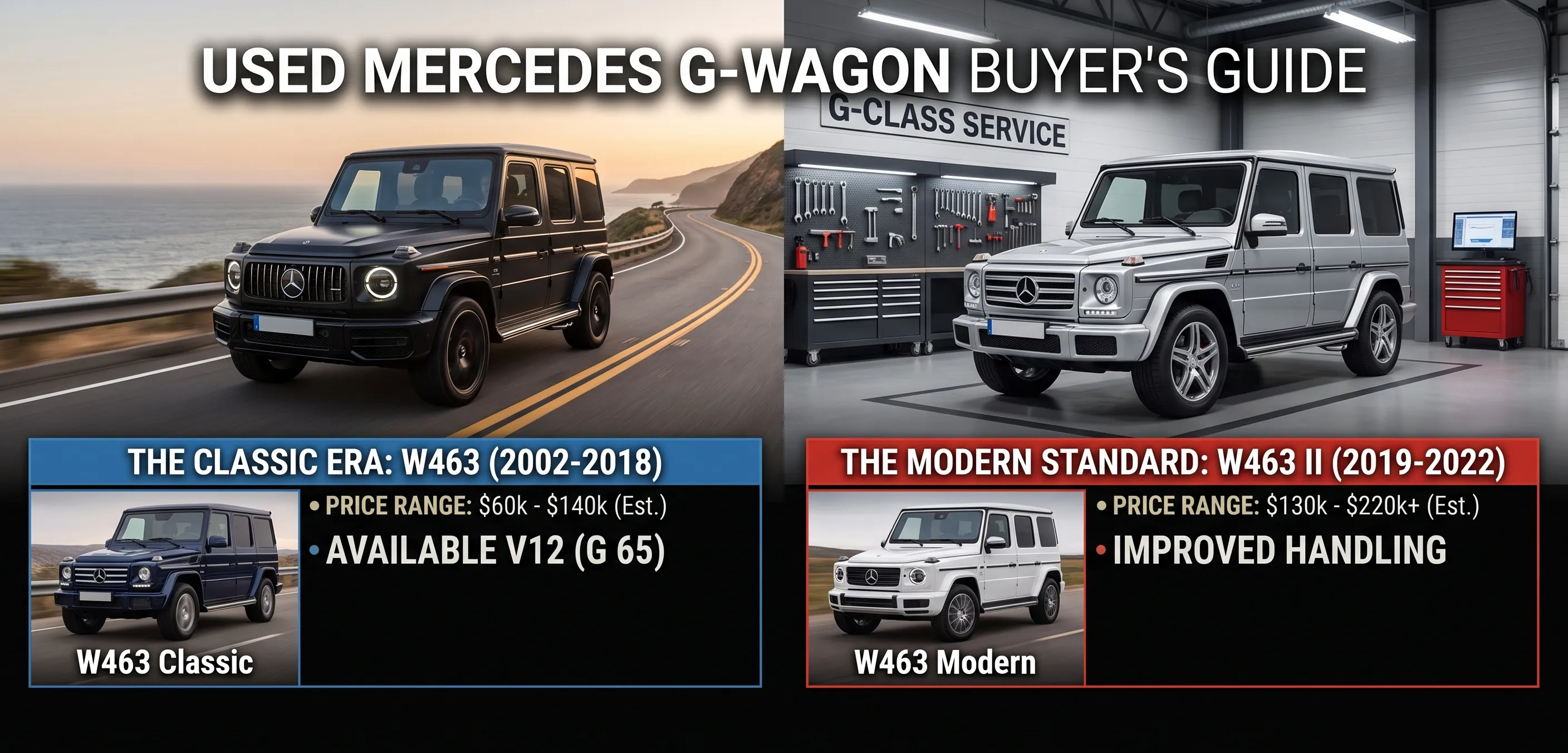
Shopping a G-Wagon during our Black Friday sale? Every G-Class on our Arlington Heights lot is up to $2,500 off through November 30. See our G-Wagon inventory →
Nothing else on the road looks like a Mercedes G-Wagon. Square. Upright. Riveted-together in a way modern cars never are. Built essentially unchanged for forty years, then reengineered in 2019 without losing a single piece of its character. It is a design so successful that Mercedes has never seriously considered replacing it — because there is nothing to replace it with.
But buying a used G-Class is not like buying a used SUV. Prices hold like nothing else in the segment. Reliability patterns are specific and expensive when they break. Generation differences (W463 vs. W463A) mean two G-Wagons that look identical from thirty feet away are actually meaningfully different vehicles.
Here is the complete buyer's guide from our shop in Arlington Heights, where we buy, sell, and service G-Wagons every month.
The Two Generations You Need to Understand
W463 (1990–2018) — The Original
The original G-Wagon platform. Body-on-frame construction. Three fully locking differentials (front, center, rear). Solid axles at both ends. Recirculating-ball steering. Interior design that was refreshed in the late-2000s but retained the fundamental narrow, upright feel of a 1979 military vehicle. Iconic, imperfect, and completely without a real competitor.
W463A (2019–Present) — The Modern Refresh
Completely re-engineered — same iconic exterior silhouette but with an entirely new interior, independent front suspension, updated 4MATIC system, and a significantly refined on-road driving experience while retaining all the off-road capability. If you have never driven both, the W463A feels like a modern luxury SUV that looks like a G-Wagon. The original W463 feels like a 1980s military vehicle with leather seats.
Both are correct choices depending on what you want. The right question is not "which is better." It is "which G-Wagon experience are you actually buying?"
G550 vs. AMG G63: The Difference That Matters
Every G-Wagon sold new since roughly 2016 comes in either the base G550 or the AMG G63. Different engines, different characters, meaningfully different used prices.
G550 (2016–2018 W463)
- Engine: M176 4.0L twin-turbo V8, 416 horsepower.
- 0–60 mph: 5.8 seconds.
- Character: Smooth, capable, luxurious. Feels expensive. Sounds refined.
- Sweet spot: 2016–2018 G550 with 40,000–70,000 miles.
AMG G63 (2016–2018 W463)
- Engine: M157 5.5L twin-turbo V8, 563 horsepower.
- 0–60 mph: 5.3 seconds.
- Character: Louder, angrier, sound-designed to make a statement. Genuinely quick.
- Sweet spot: 2016–2018 G63 with the M157 5.5L V8.
G550 (2019+ W463A)
- Engine: M176 4.0L twin-turbo V8, 416 horsepower.
- 0–60 mph: 5.6 seconds.
- Character: All the previous G550 refinement, on-road driving significantly improved.
- Sweet spot: 2019–2021 G550 with documented service.
AMG G63 (2019+ W463A)
- Engine: M177 4.0L twin-turbo V8, 577 horsepower.
- 0–60 mph: 4.5 seconds.
- Character: The definitive modern G-Wagon. Absurdly quick, exquisitely trimmed, unlike anything else on the road.
- Sweet spot: 2019+ G63 with 20,000–50,000 miles.
Common Issues to Check Before You Buy
The G-Wagon is a genuinely durable vehicle, but its complexity — three locking differentials, four-wheel disc brakes with parking brake integration, twin-turbo V8s, and lots of trim-piece hardware — means specific items require attention.
Front and Rear Differential Seals
On W463 (pre-2019) G-Wagons, front and rear differential seals develop leaks around 60,000–100,000 miles. Small leak is a $400–$700 repair. Ignored leak eventually damages the differential ring gear — a much larger repair.
Check: Look for oil residue on the front axle housing and rear differential. Any wetness is worth negotiating.
Front Locking Differential Actuator
On some W463 G-Wagons, the front locker actuator sticks or fails. Symptoms: the lock icon on the dashboard doesn't turn on, or the front driveshaft binds during tight parking-lot turns.
Check: Ask the seller to demonstrate all three differential locks engaging in sequence (rear, center, front — in that order). Any lock that doesn't respond is a red flag.
AMG G63 M157 Timing Chain Guides (pre-2019)
The M157 5.5L twin-turbo V8 has documented timing chain guide wear on higher-mileage examples.
Check: Cold-start rattle lasting more than a second is a walk-away. Ask for maintenance records.
G550 M176 Turbo Wastegate Rattle (2019+)
Some early W463A G550s developed wastegate rattle around 30,000–60,000 miles. Not always a functional failure but noisy and eventually requires turbo service.
Check: Listen for a metallic rattle at 1,500–2,000 rpm under light load.
Air Suspension (W463A Only)
The 2019+ W463A moved to adaptive damping (not full air suspension, but adaptive). Failure of adaptive dampers is a known cost item.
Corrosion on the Undercarriage (Especially Chicago-Area Vehicles)
The G-Wagon's chassis is a big steel ladder frame. Salt exposure builds rust on the frame, differentials, and driveshafts.
Check: Underbody inspection is mandatory on any G-Wagon that has spent Chicago winters on salted roads. A shop with a lift can complete this in fifteen minutes.
Fuel Consumption Reality
The G-Wagon is a body-on-frame square SUV with a twin-turbo V8. Real-world fuel economy: 12–14 mpg city, 15–17 mpg highway. This is not "less than advertised." This is what the vehicle actually gets, and every G-Wagon owner accepts it. If you cannot, this is not the SUV for you.
The Value Curve: What a Used G-Wagon Actually Costs Over Time
The G-Wagon is one of the very few luxury SUVs whose used values hold nearly-new. A three-year-old G550 might sell for 80–85 percent of its original MSRP. A three-year-old G63 sometimes sells for more than the buyer paid new, because AMG G63 production has been supply-constrained for years.
Understanding this changes the used G-Wagon math:
- The G-Wagon is a hold-value luxury purchase, not a depreciation play like most other used luxury SUVs.
- Buying used at 30,000–50,000 miles saves meaningful money vs. new but not the 40–50 percent discount you would get on a used BMW X5 or Mercedes GLS.
- Buying used at 80,000–120,000 miles moves the value curve back into your favor, but you inherit the maintenance obligations of a heavily used specialized SUV.
The sweet spots for most buyers:
- Best on-paper value: 2019–2020 G550 or G63 with 30,000–50,000 miles.
- Deepest discount: 2016–2018 W463 G550 with 60,000–90,000 miles and documented service.
- Iconic status: Any G63 in interesting colors (Designo Manufaktur options).
For the full picture of what luxury ownership costs beyond the purchase price, see our guide to Hidden Costs of Luxury Car Ownership.
The G-Wagon as a Chicago Winter SUV
This is where the G-Wagon separates from every competitor. Three locking differentials, 9.5 inches of ground clearance, 4MATIC full-time AWD, body-on-frame construction. When Rand Road hasn't been plowed and your side street has six inches of unbroken snow, the G-Wagon simply goes.
The tradeoffs are equally real. Wide turning circle. Twelve-mpg fuel consumption. Wind noise on the highway. Parking is a genuine skill. The G-Wagon rewards owners who chose it for what it is and frustrates owners who wanted a G-Wagon that behaved like a GLE.
What to Ask for at the Test Drive
- Complete service history from the seller (Mercedes-Benz Star Service records ideal).
- Confirmation of any AMG performance-warranty history for G63 examples.
- Written documentation of differential fluid service history.
- Underbody inspection photos or in-person confirmation of no salt corrosion.
- Demonstration of all three differential locks engaging in sequence.
- Confirmation of tire age and condition (a G-Wagon on 5-year-old tires with heavy tread wear is a bargaining item).
- A full XENTRY diagnostic scan — any stored fault codes should be shared and discussed.
The Bottom Line
A used G-Wagon is a specific choice. It is not the SUV to buy for pragmatic reasons. It is the SUV to buy because you want a G-Wagon — the design, the presence, the drivetrain that does not care about weather, the interior craftsmanship that reminds you every drive why you paid for it.
Buy carefully. Verify service history. Insist on a physical inspection with the underbody visible. And know exactly which G-Wagon experience you are buying — a classic W463 or a modern W463A, a refined G550 or a snarling AMG G63.
The buyer who understands the tradeoffs owns one of the most rewarding vehicles on the road. The buyer who does not understand them owns a very expensive lesson.
Shop G-Wagons at Autos of Chicago
We regularly stock G-Wagons — G550s and AMG G63s across model years. Every G-Wagon we sell is inspected in our own service department: XENTRY scan, underbody corrosion check, differential fluid inspection, all three lockers verified. We know these vehicles inside and out because we service them for owners across the Northwest Suburbs.
Browse Our G-Wagon Inventory →
Or call us at (224) 858-4007 to talk through a specific vehicle.
Address: 1555 E Rand Rd, Arlington Heights, IL 60004


