
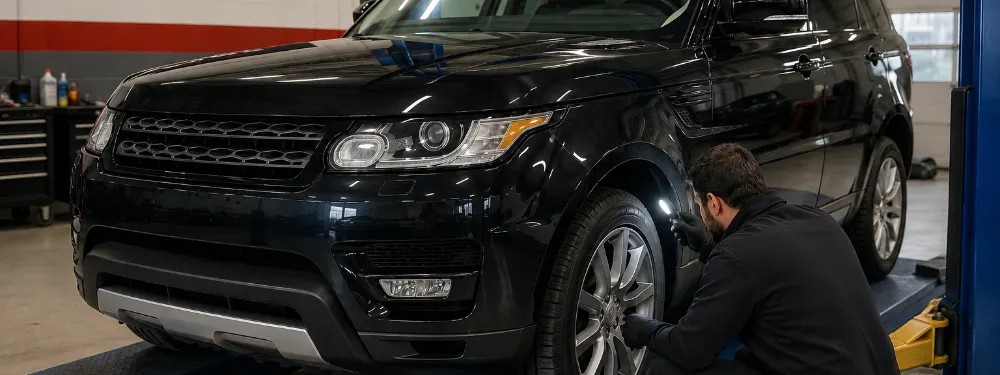
Range Rover Reliability: What Actually Breaks, What It Costs, and Which Years to Buy
Short answer: Range Rovers are less reliable than a Lexus or Toyota, and they cost more to keep on the road. Expect $4,000–$6,000 a year in maintenance and repairs on a used one. But most of the horror stories come from owners who skipped maintenance. A well-documented 2018–2020 Range Rover, serviced on a 5,000–7,500-mile oil schedule by a Land Rover specialist, routinely reaches 150,000+ miles.
We sell and service Range Rovers every day at our Arlington Heights shop. Below is what actually fails, the mileage it usually fails at, what it costs to fix at an independent shop, and the model years we would buy ourselves.
Range Rover Reliability at a Glance
| System | What fails | Typical mileage | Independent shop cost | How to prevent it |
|---|---|---|---|---|
| Air suspension | Air springs crack, compressor burns out, line leaks, height sensors | 60,000–110,000 | $350–$650 per spring; $800–$1,400 compressor | Fix slow-rise or overnight sagging early, before it kills the compressor |
| Coolant pipes & tank | Plastic pipes and tank crack, especially under the supercharger | 60,000–90,000 | $250–$800 per leak | Replace plastic crossover pipes with upgraded aluminum ones before they fail |
| Timing chain guides (5.0L V8, 3.0L) | Guides wear, causing a cold-start rattle | 80,000–130,000 | $4,000–$7,000 | Change synthetic oil every 5,000–7,500 miles, not the factory 15,000+ |
| Transfer case actuator | Motor sticks and you lose low range / 4WD | 60,000–100,000 | $1,200–$1,800 | Use low range a few times a year so it doesn't seize |
| Batteries & electrics | Weak battery triggers false warning lights and frozen screens | Every 3–4 years | $300–$700 (battery plus coding) | Test both batteries every fall and replace them together |
| ZF 8-speed transmission | Usually reliable; fails mainly when the fluid is never changed | Service every 60,000–80,000 | $500–$800 service (vs ~$9,000 rebuild) | Ignore "lifetime fluid" and service it on schedule |
Why Range Rovers Have a Bad Reliability Reputation
Land Rover regularly finishes near the bottom of Consumer Reports and J.D. Power rankings. That reputation is earned, but those surveys count a Bluetooth glitch the same as an engine failure. On the Range Rovers we see in our shop, the expensive problems almost always trace back to one of three things:
- Oil changes stretched too far. Factory intervals of 15,000+ miles are hard on timing chain guides and valve timing parts. Owners who change synthetic oil every 5,000–7,500 miles rarely need a timing job.
- Tired batteries. A Range Rover runs dozens of computer modules. When a battery drops from 12.6V to about 12.1V, the dash can light up with suspension, brake and blind-spot warnings even though nothing mechanical is wrong.
- Chicago weather. Swings from 95°F summers to -15°F winters age the plastic coolant parts under the hood faster. By 60,000–80,000 miles they are due.
A Range Rover treated like an economy car will punish its owner. A Range Rover maintained on a specialist schedule is a very different ownership experience.
The 6 Things That Actually Break (and What They Cost)
1. Air Suspension: the Biggest One
Every modern Range Rover and Range Rover Sport rides on four-corner air suspension. It gives the limousine ride and the adjustable height, and it is the single most common repair.
- Air spring (bag), usually rear first: $350–$650 per corner
- Compressor: $800–$1,400
- Air line leaks at fittings: $200–$400
- Height sensors: $150–$300 each
- Valve block: $400–$700
Warning signs: it takes longer than usual to rise after you start it, or one corner sits low overnight. Fix the leak then, because a leaking system makes the compressor run nonstop until it burns out.
2. Coolant Leaks
The plastic expansion tank, connectors and crossover pipes on the 3.0L and 5.0L supercharged engines are known to crack. Each leak is $250–$800 to fix. If the coolant level keeps dropping and you can't see a leak, get it checked before it overheats the engine. We recommend replacing the factory plastic crossover pipes with upgraded aluminum ones.
3. Timing Chain Guides (5.0L Supercharged V8)
Found on Supercharged, Autobiography and SVR models, usually between 80,000 and 130,000 miles. A full timing chain guide job is $4,000–$7,000 at an independent shop.
How to check: start the engine completely cold and listen for the first two seconds. Any metallic rattle is a red flag.
4. Transfer Case Actuator (Loss of 4WD)
Common on 2013–2021 (L405) Range Rovers between 60,000 and 100,000 miles. You'll see "Terrain Response Fault" or "Low Range Selection Fault." Replacement is $1,200–$1,800. Actuators that are never used corrode and stick, so use low range a few times a year.
5. Electrical Gremlins
Infotainment freezes, Bluetooth drops, and warning lights that come and go are common on 2013–2021 models. Most are fixed with a healthy battery and a software session on Land Rover's dealer-level diagnostic software (Pathfinder or SDD). A shop without that software will often replace parts that aren't broken.
6. Transmission: Actually the Good News
The ZF 8-speed automatic is one of the most reliable parts of the vehicle. Most failures come from never changing the fluid, because Land Rover calls it "lifetime." Service it every 60,000–80,000 miles for $500–$800. Skip it and you risk a ~$9,000 rebuild. We do transmission service in Arlington Heights for Land Rover and every other make we sell.
Best and Worst Range Rover Years to Buy
Best: 2018–2020 Range Rover (L405) and Range Rover Sport (L494)
This is the sweet spot. By 2016 Land Rover had updated the timing chain parts and water pumps, and the 2018 refresh sorted out more of the electronics. The aluminum body is about 800 lbs lighter than the previous generation, which means less wear on suspension and brakes. The 3.0L supercharged V6 with the ZF 8-speed is the drivetrain our technicians trust most.
Look for: 60,000–100,000 miles, records showing coolant and air suspension work, and no cold-start rattle.
Good with records: 2016–2017 L405 / L494
These include the updated timing parts. Buy one only with a full service history.
Be careful: 2013–2015 L405 / 2014–2015 L494
These early years had the most electrical and timing chain complaints. Walk away if there are no records, if the air suspension has known problems, or if you hear a cold-start rattle.
Budget pick: 2010–2012 Range Rover (L322)
These are the most refined years of the older generation. The survivors still on the road have usually had their known problems fixed already. Have the 5.0L timing chain guides inspected, and only buy one if you have a specialist lined up.
Newest: 2022+ Range Rover (L460) and 2023+ Sport (L461)
These use a new platform with BMW-sourced 4.4L twin-turbo V8 or mild-hybrid six-cylinder engines. Early reports are positive, but there isn't enough long-term data yet. If you buy one, buy it with factory warranty remaining.
Other Land Rovers
- Evoque: the 9-speed transmission is the weak point. Buy 2018+ with the software updates and fluid service documented.
- Velar: middle of the lineup for reliability. Look for a well-documented example under 100,000 miles.
- Discovery / LR4: similar issues to the Range Rover (air suspension, coolant), usually at a lower purchase price.
- Defender (2020+): a new platform. Early feedback is positive, but it's too new for a firm verdict.
What a Used Range Rover Really Costs Per Year
If you drive about 12,000 miles a year, budget:
- Routine maintenance: $1,200–$1,800 per year
- Unplanned repair fund: $2,000–$3,500 per year
- Air suspension work over 5 years: $2,500–$5,000 total
- Timing chain guides (5.0L V8, over 10 years): $4,000–$7,000
Realistic total: $4,000–$6,000 per year at an independent specialist, more at the dealer. Owners who plan for these numbers keep their Range Rovers for years. Owners who don't plan for them usually sell within 18 months.
Our 10-Point Used Range Rover Inspection Checklist
Check these yourself before you pay for a professional inspection:
- Cold start: no rattle in the first 2 seconds
- The vehicle rises to normal height within about 30 seconds of starting
- No corner sits low after sitting overnight
- The coolant reservoir is at the correct level, with no sweet smell or crusty residue
- Switch from high to low range (Terrain Response) with no fault message
- No warning lights on the dash, and the infotainment screen doesn't freeze
- Records show oil changes at 7,500 miles or less
- Transmission fluid has been serviced at least once past 60,000 miles
- Both batteries are less than 4 years old
- A scan with dealer-level Land Rover software (Pathfinder or SDD) shows no stored faults
Want us to do it for you? Bring any Range Rover, including one from another seller, to our Arlington Heights service department for a pre-purchase inspection before you write the check.
Is a Range Rover Worth It?
If reliability were the whole story, nobody would buy one. People buy Range Rovers for the ride, the interior, the road presence, and real off-road ability, and a well-kept ten-year-old Range Rover still feels like a Range Rover. Buyers who understand the trade-off and budget for it are happy owners. Buyers who hope for the best usually learn an expensive lesson.
Frequently Asked Questions
Can a Range Rover last 200,000 miles?
What is the most reliable Range Rover year?
What Range Rover years should I avoid?
Why do Range Rovers score so low in reliability surveys?
Are Range Rovers good in Chicago winters?
Buy a Range Rover That Has Already Passed Our Shop
Every Land Rover we sell is scanned with dealer-level Land Rover diagnostics, has its air suspension pressure-tested, has its transmission fluid checked, and is physically inspected in our own service department. We know where these vehicles hurt because we fix them every day.
Browse our Land Rover inventory → Call (224) 858-4007
Autos of Chicago · 1555 E Rand Rd, Arlington Heights, IL 60004
Serving Arlington Heights, Schaumburg, Palatine, Glenview, Des Plaines, Naperville, Hoffman Estates and all of Chicagoland.


