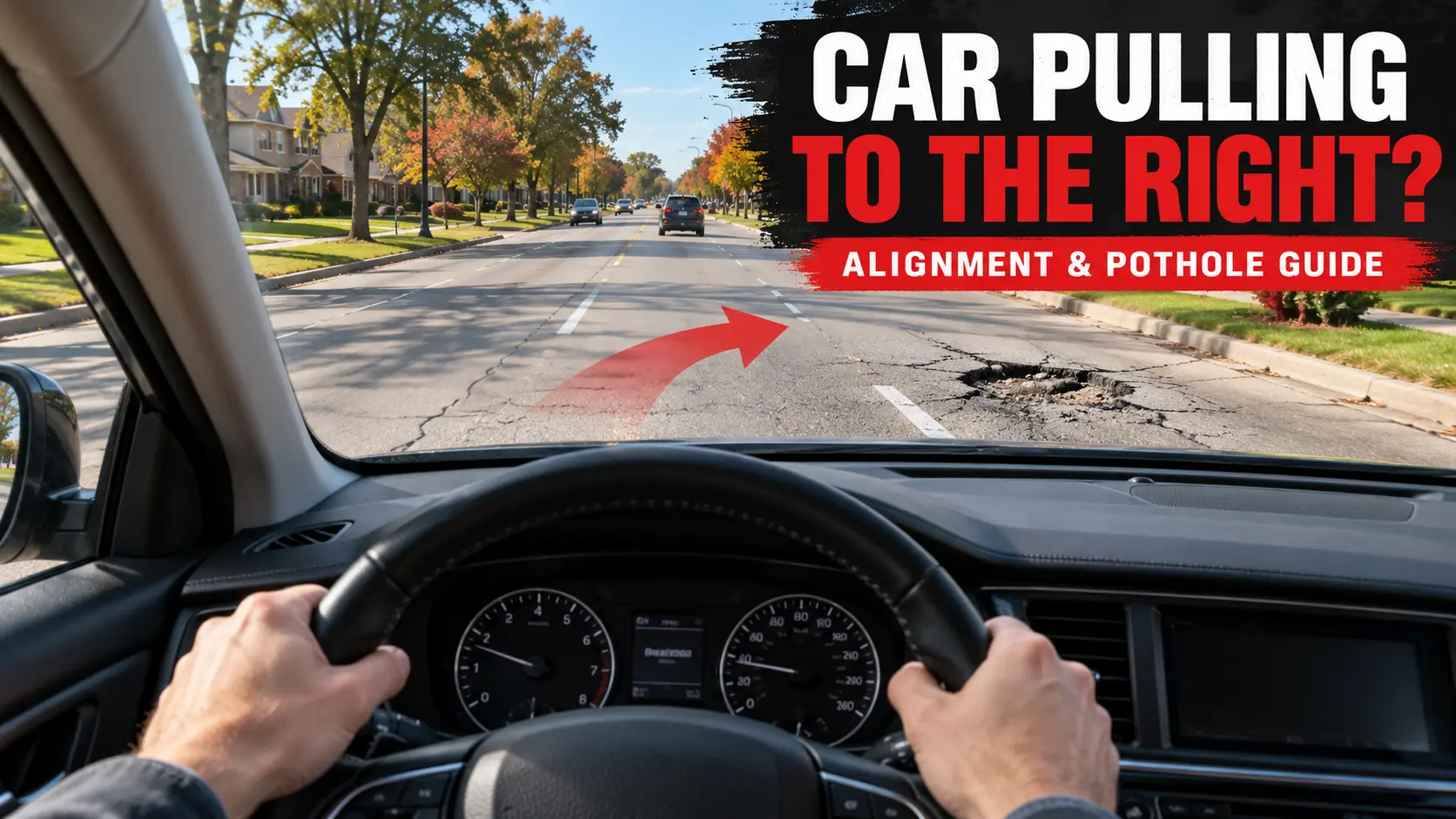
You are cruising down Route 53 or Rand Road, let go of the steering wheel for two seconds, and your vehicle immediately veers toward the shoulder. Here is the engineering science behind vehicle drift, how Midwest freeze-thaw cycles destroy suspension geometry, and what a computerized alignment actually corrects.
Driving throughout Arlington Heights, Schaumburg, and the greater Chicago Northwest Suburbs requires navigating some of the harshest road infrastructure in the Midwest. Every winter, moisture seeps deep into asphalt fractures, freezes, expands, and collapses under heavy truck traffic along the Jane Addams Memorial Tollway (I-90) and Northwest Highway. The result is an obstacle course of sharp, rim-bending potholes and jagged frost heaves.
Taking a direct hit from a 4-inch-deep crater at 45 MPH transmits thousands of pounds of kinetic energy directly through your tire, alloy rim, ball joints, and steering tie rods. Even if your tire doesn't blow out, that violent shock load is more than enough to bend stamped steel control arms, compress rubber bushings, and knock your vehicle’s factory alignment out of specification.
At Autos of Chicago Service Center, located at 1555 East Rand Road in Arlington Heights, IL, our computerized chassis lab realigns dozens of commuter and luxury vehicles every week. Below is our comprehensive 2027 technical guide explaining suspension angles, tire destruction metrics, repair cost matrices, and coupon savings.
The Engineering Angles: Camber, Caster, and Toe Explained
When your car tracks straight, its steering and suspension geometry relies on three critical mathematical angles measured down to hundredths of a degree:
-
1. Toe Angle (The Tire Destroyer):
Toe represents the inward or outward angle of the tires when viewed directly from above, like looking down at your feet. If the fronts of the tires point inward toward each other, it is Toe-In; if they flare outward, it is Toe-Out. Even a minor toe error of 0.17 degrees (less than 1/16th of an inch) forces the tire to scrub sideways across the pavement. This sideways drag causes rapid "feathering"—a sharp, saw-toothed wear pattern across the tread blocks that generates a loud highway droning sound often mistaken for a bad wheel bearing. -
2. Camber Angle (Shoulder Wear & Side Pull):
Camber is the inward or outward vertical tilt of the wheel when viewed directly from the front of the vehicle. If the top of the tire tilts outward away from the engine, it is Positive Camber; if the top tilts inward toward the chassis, it is Negative Camber. Hitting a Chicago curb or deep pothole frequently bends the lower control arm or strut housing, knocking camber into excessive negative territory. This concentrates the entire vehicle's weight onto the inner 2 inches of the tire, grinding the inner shoulder down to the steel safety belts while the outer tread looks brand new. -
3. Caster Angle (Directional Stability & Steering Return):
Caster is the forward or backward tilt of the steering pivot axis when viewed from the side of the car, similar to the front forks on a bicycle. Positive caster tilts the pivot backward, creating self-centering steering force that keeps the car tracking straight at 70 MPH on the highway. If a pothole shoves a front wheel rearward by just 0.50 degrees relative to the other side, the vehicle will pull relentlessly toward the side with less caster.
⚡ Arlington Heights Precision Alignment Special
Hit a Pothole? Check Your Angles for Free
Take advantage of our Complimentary Computerized Alignment Check. If adjustments are needed to protect your tires, save 15% on complete 4-wheel alignment with code ALIGN15W.
The Hard Data: How Pothole Impacts Destroy Tire Investment
Ignoring an alignment issue is one of the most expensive mistakes a Cook County car owner can make. Consider the real-world statistical degradation caused by unaligned geometry:
- The 28-Foot Sideways Drag: A toe misalignment of just 0.17 degrees drags the tread sideways across coarse asphalt for 28 feet every single mile. Over a standard 1,000-mile suburban commuting month, your tires are dragged sideways for over 5.3 miles.
- 30% to 50% Reduction in Tire Lifespan: A premium set of all-season tires (such as Michelin CrossClimate2 or Continental ExtremeContact) engineered to deliver 60,000 miles can be scrubbed down to bald cords in under 18,000 to 22,000 miles if driven on unaligned suspension.
- Fuel Economy Penalty: Increased rolling resistance from misaligned tires scrubbing the road forces your engine to burn an extra 2.5% to 4.0% in fuel, costing suburban commuters an extra $120 to $180 annually at the pump.
- Pothole Impact Severity: Department of Transportation studies confirm that striking an average Chicago freeze-thaw pothole at 35 MPH generates a peak impact force of up to 1,800 to 2,200 pounds on lower control arm ball joints and tie rod sleeves.
Cost Breakdown: Autos of Chicago vs. Dealership vs. National Chain (2026 Data)
Alignment and suspension service pricing varies across northern Illinois depending on whether modern diagnostic resets and 4-wheel laser sweeps are included. Here is how real-world costs compare:
| Alignment Service Scope | Procedures & Hardware Included | Autos of Chicago | Franchise Dealership | National Chain Shop |
|---|---|---|---|---|
| Computerized Alignment Check | Laser camera target mounting, full 4-wheel diagnostic sweep, printout of Camber, Caster, and Toe angles. | FREE (With coupon ALIGN15W) |
$65 – $95 | $29 – $49 |
| Full 4-Wheel Computerized Thrust Alignment | Complete 4-wheel front and rear Camber, Toe, and Caster adjustments, steering wheel centering, digital before-and-after audit. | $115 – $145 (Less 15% with ALIGN15W) |
$195 – $275 | $130 – $165 |
| Steering Angle Sensor (SAS) Electronic Re-Zero | OBD-II diagnostic calibration of electronic stability control, lane-keep camera zeroing, and steering column position reset. | Included With Alignment | +$75 – $120 Extra | Often Skipped (Causes Warning Codes) |
⚠️ Master Technician Warning: The "Front-Only" Alignment Shortcut:
Budget tire shops frequently offer quick "$79 front-end alignments." On modern multi-link independent rear suspensions, a front-only alignment is an incomplete repair. If the rear toe angle is knocked out by a pothole, the rear axle pushes the vehicle sideways at an angle (known as a non-zero Thrust Angle). The car will "crab-walk" down the highway, forcing you to hold the steering wheel crooked at a 15-degree angle just to drive straight forward.
Professional Equipment & Diagnostics: The Hunter Hawkeye Elite Difference
An alignment is only as accurate as the optical measurement rack reading your chassis. At Autos of Chicago, we utilize industry-benchmark diagnostic hardware:
- Hunter Hawkeye Elite 3D Optical Imaging: Our drive-on alignment rack uses four high-resolution digital cameras and non-contact QuickGrip wheel adapters. These clamp securely over the tire rubber with zero metal-to-rim contact, preventing scratch damage on expensive factory alloy or custom wheels.
- Live Unibody & Setback Diagnostics: The Hunter system measures Axle Setback and Track Width Differential. If a pothole pushed your front wheel hub rearward by even 0.125 inches, the software highlights the exact bent suspension component (strut tube vs. lower control arm) before wrenches touch the car.
- OEM Heavy-Duty Replacement Hardware: If an adjustment sleeve is frozen from winter salt or a tie rod is bent, we install premium forged components from trusted OE manufacturers like Moog Problem Solver and Lemförder.
- Electronic SAS Zero-Point Calibration: Using Snap-on Zeus+ and Autel MaxiSys Elite scan tools, our technicians connect directly to the vehicle's gateway module to reset the steering angle sensor, ensuring that your vehicle’s anti-lock braking and lane-keeping safety systems match your mechanical alignment.
How to Choose: Evaluating Suspension Wear Before You Align
An alignment adjustor can only compensate for adjustable angles. If supporting rubber or steel suspension components are physically worn out, an alignment will not hold for more than 50 miles. Use this checklist:
- 1. Check Tie Rod Play First: Inner and outer tie rods link the steering rack to the wheel knuckles. If a technician attempts to set toe while tie rod ball-joints have mechanical play, the wheel will vibrate and shift angles the moment you hit highway speeds.
- 2. Inspect Control Arm Bushings for Tearing: Liquid road brine causes rubber control arm bushings to dry rot and tear. When bushings crack, the entire wheel shifts forward and backward under hard acceleration and braking, making constant alignment impossible.
- 3. Verify Tire Pressure Before Mounting the Rack: An under-inflated tire sits 0.5 inches lower than an inflated tire, throwing off physical camber measurements. A professional shop always balances tire pressures across all four corners before running optical measurements.
- 4. Demand a Color Digital Before-and-After Printout: Reputable service facilities provide a digital printout showing exact degrees for Camber, Caster, and Toe before adjustment (in Red) and after adjustment (in Green) matching OEM factory ranges.
Got Questions About Wheel Alignment in Cook County?
Everything you need to know about steering wheel drift, pothole damage, and alignment specials.
Why does my car pull to the right even on freshly paved highways?
How quickly does bad wheel alignment ruin brand-new tires?
What is the difference between a 2-wheel alignment and a 4-wheel computerized thrust alignment?
Why must the Steering Angle Sensor (SAS) be electronically reset after an alignment?
How much does a four-wheel alignment cost in Arlington Heights in 2027?
Protect Your Tires with Precision Laser Alignment
Don't let Chicago potholes ruin your tires. Book your complimentary alignment check today and save 15% on complete 4-wheel computerized alignment service with coupon code ALIGN15W.
Service Facility: 1555 East Rand Road, Arlington Heights, IL 60004
Direct Service Desk: (224) 888-4007
Hours: Monday – Friday: 8:00 AM – 6:00 PM | Saturday: 8:00 AM – 4:00 PM
VIP Ownership Perks Included with Vehicle Protection Plans
Customers who safeguard their investment with an extended service contract through Autos of Chicago gain access to our complete suite of dealership ownership perks—including scheduled synthetic oil services, comprehensive multi-point safety inspections, 24/7 emergency roadside assistance, and professional post-purchase detailing certificates. Learn more about plan options on our vehicle protection plans page.
*Program Terms & Qualification Disclaimer: Ownership perks, maintenance credits, roadside assistance, detail vouchers, and trade-in bonuses referenced across our website and promotional materials are available exclusively to qualified customers who purchase an eligible extended vehicle protection plan or vehicle service contract at Autos of Chicago at the time of vehicle sale. Vehicle eligibility varies based on make, model, age, mileage, and underwriting approval from participating warranty administrators. Complimentary services are non-transferable, carry no cash value, and are administered strictly according to the specific written schedule, coverage tiers, and deductible provisions detailed in your signed agreement. Cannot be combined with standalone wholesale clearance pricing unless approved in writing by dealership management. Visit our Arlington Heights showroom or contact our finance department at (224) 888-4007 for complete written terms, exclusions, and vehicle qualification details.


