Why the BMW i8 Is the Smartest Used Sports Car Buy in America
The i8 you have been watching just got better. Every i8 on our Arlington Heights lot is up to $1,700 off through July 31. Browse i8 inventory →
Occasionally, the used car market opens a window. A specific vehicle — one that was expensive new, is technically extraordinary, has aged well mechanically, and has been misunderstood by mainstream buyers — briefly settles at a price point that makes it a genuine bargain. The BMW i8 is in that window right now.
At Autos of Chicago, we stock i8s across model years. Every time we sell one, the buyer walks away with the same slight disbelief — the car is significantly better than its reputation suggested, and the price paid is significantly lower than it deserves.
Here is the case for the used BMW i8 in 2026.
What the i8 Actually Is
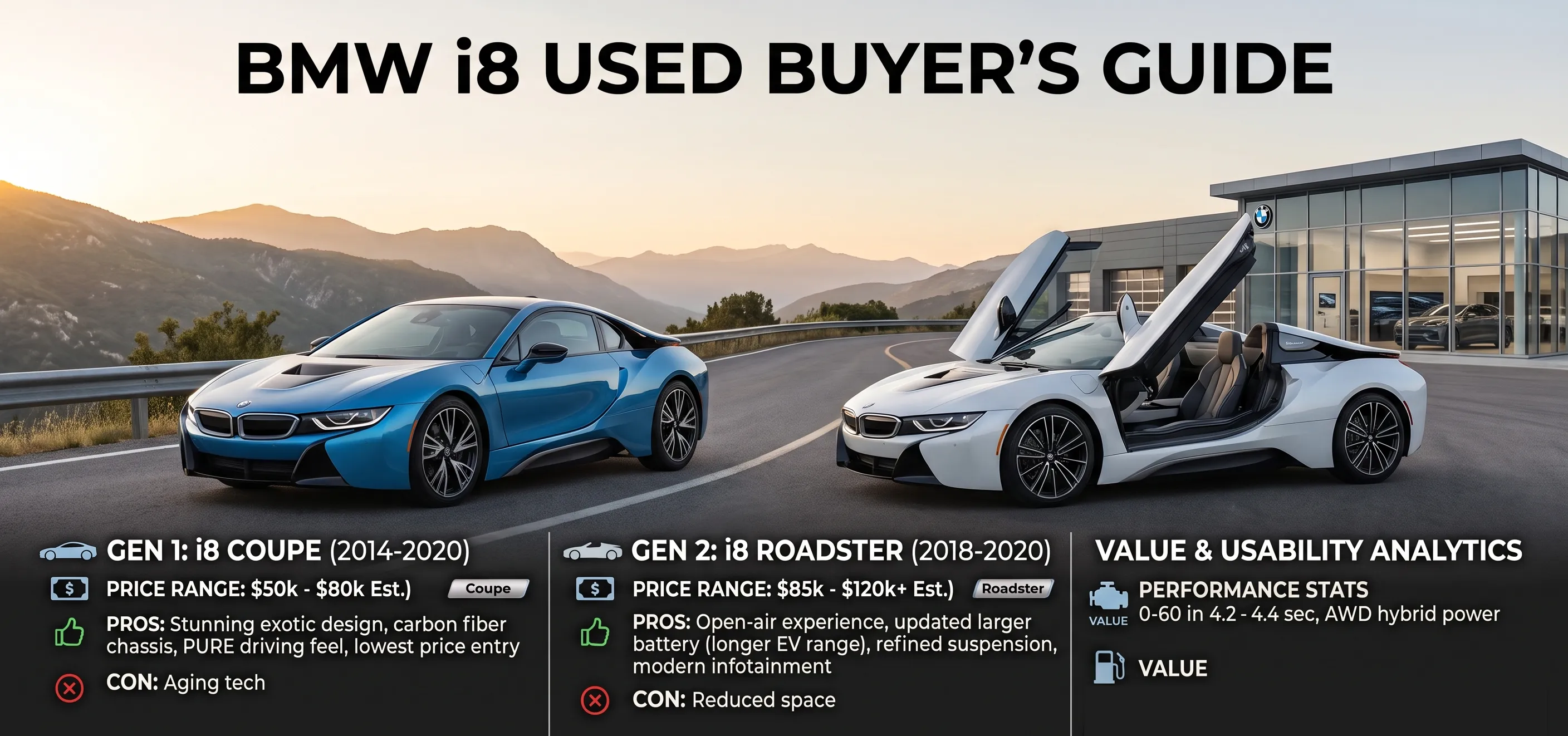
The BMW i8 is a plug-in hybrid mid-engine sports car built from 2014 to 2020. Carbon fiber reinforced plastic tub, aluminum drivetrain cradles, and a body that looks more like a concept car than a production vehicle. Butterfly doors. Laser headlights on later cars. An interior that felt genuinely futuristic when new and still does today.
The drivetrain is where the story gets interesting:
- Front axle: electric motor, roughly 141 hp.
- Rear axle: turbocharged 1.5L three-cylinder gasoline engine, roughly 231 hp (later models: 228 hp with more torque via retuning).
- Combined output: 357 hp (2014–2017) / 369 hp (2018–2020 Roadster and Coupe refresh).
- 0–60 mph: approximately 4.2 seconds.
- All-wheel drive at all times when both power sources are engaged.
The i8 was BMW's proof-of-concept for the future — a supercar that used a three-cylinder engine, electric drive, and lightweight carbon construction to deliver performance without giving up efficiency. It worked. It was misunderstood. And now the used market has caught up to what the car actually is.
Why the Used Market Missed This One
The i8 was misunderstood for three reasons:
- The engine was a three-cylinder. Enthusiasts wanted a V8 in a car that looked like this. That was never the point. But it took years for the market to accept a three-cylinder in a supercar body.
- Depreciation was steep. A car that stickered at $148,000 new dropped to $80,000, then $60,000, then $50,000 on the used market. Each price cut made enthusiasts wonder what was wrong with the car. The answer, in most cases, was nothing.
- Repair reputation. Being a hybrid, being mid-engine, being partially carbon fiber, and being niche, the i8 got a reputation for expensive repair. In reality, the drivetrain has been more reliable than most enthusiasts expected.
The window opened when the pricing bottomed out around $50,000–$65,000 for good examples. That is where we are today.
What the i8 Actually Delivers On the Road
The i8 is not the fastest sports car in its price range. It is not the most track-capable. What it is is the most special-feeling sports car under $70,000. The doors open upward. The interior wraps around the driver. The three-cylinder engine sings a genuinely unique note that BMW acoustically enhanced through the audio system. Electric-only mode delivers silent acceleration for the first fifteen to twenty miles of a drive. Sport mode wakes the engine and the character shifts entirely.
You do not buy an i8 to beat a 911 in a straight line. You buy it because there is nothing else that feels like it, and nothing else that looks like it. On a used market where character is disappearing under waves of homogenized crossovers, that matters.
Reliability
The i8's reliability has been better than the internet reputation suggests, largely because the drivetrain is fundamentally under-stressed:
- B38 three-cylinder engine: essentially the same engine as in the BMW i8's small-car siblings, but with fewer miles because i8 owners typically drive their cars less. Generally reliable.
- Electric motor and lithium-ion battery pack: covered by BMW's electric drive component warranty (8 years / 100,000 miles). The battery pack has held up well in real-world use — capacity loss on well-maintained i8s has been modest.
- Six-speed automatic transmission (rear axle): proven BMW gearbox.
- Suspension and brakes: conventional, serviceable at any competent shop.
Known issues to check:
- 12V battery: early i8s (2014–2016) had frequent 12V battery drain complaints. Most have been addressed by battery replacement and firmware updates.
- Fuel pump: documented failures on some examples requiring replacement.
- Range extender fuel tank ventilation: occasional evaporative emissions codes.
- Interior wear: the leather and Alcantara wear predictably on hard-used cars.
- Wheel and tire cost: i8 rides on specialized narrow low-rolling-resistance performance tires from Bridgestone. Not cheap, and not available at every tire shop.
Overall, the i8 has been a lower-repair-frequency ownership experience than most enthusiasts feared. Preventive maintenance costs run $800–$1,500 per year at an independent BMW specialist.
The Value Argument
The math is straightforward.
- New price (2019–2020 Coupe): approximately $148,000.
- Used price (2019–2020, 20,000–50,000 miles) today: $58,000–$68,000.
- Depreciation captured: roughly $80,000–$90,000.
For under $65,000, you get a mid-engine plug-in hybrid sports car with butterfly doors, all-wheel drive, a genuinely unique driving experience, and design that will read as futuristic for the next decade. There is nothing else in that price range that delivers the same combination of things.
The i8 will not appreciate significantly in the next few years. But it has essentially bottomed out — and when the market realizes what this car actually is, that floor will hold and gradually rise. In the meantime, you drive one of the most special cars of the decade for the price of a nicely equipped BMW M4.
Who the i8 Is Not For
- Anyone who wants the fastest thing in the neighborhood. It is not.
- Anyone who tracks their sports car. It is not built for that.
- Anyone who thinks a three-cylinder engine belongs in a lawnmower rather than a supercar body. Do not fight your instincts.
Who the i8 Is Perfect For
- Design enthusiasts who prioritize how a car looks and feels above raw specification.
- Buyers who want a genuinely different sports car experience without the finances or reliability commitment of a Ferrari, Lamborghini, or McLaren.
- Chicago-area drivers who want a plug-in hybrid that can commute silently on electricity for the first twenty miles of a drive.
- Anyone who wants to own a piece of automotive history — the i8 was the first truly serious carbon-fiber-tub production sports car under $200,000, and it was BMW's genuine attempt to reinvent what a supercar could be.
What to Check Before You Buy
- 12V battery age (replaced within the last two years is ideal).
- Fuel pump service history.
- Battery state of health report from BMW or a qualified BMW specialist.
- Full ISTA diagnostic scan showing no stored codes.
- Tire age (five-year-old tires need replacement regardless of tread).
- Butterfly door hinge operation (rare failure but expensive if it happens).
- Interior condition — Alcantara-heavy interiors wear quickly on hard-used cars.
Buy an i8 at Autos of Chicago
We stock BMW i8s regularly across model years. Every i8 we sell has been inspected in our own service department with full ISTA diagnostic scan, battery state-of-health verification, and physical inspection.
Call (224) 858-4007. 1555 E Rand Rd, Arlington Heights, IL 60004.